
Actaea rubra
Native to moist wooded plant communities throughout the Coast Ranges and the Sierra Nevada. The attractive astilbe-like foliage emerges in the early spring. The tiny white flowers have no petals and are made up of clusters of creamy white stamens. The spikes of vivid, shiny red berries are very showy though poisonous - hence the common name baneberry. A wonderful addition to shady situations with some summer water. Goes dormant in the winter. Deer resistant.

Actaea rubra – white fruited form
This is the special white fruited form of the more commonly seen red fruited baneberry. We are not sure how true these will come from seed and suspect there will be some red berries showing up in this crop. So far we have had only white fruits coming from this seed source, but we will have to see how the entire crop develops. Baneberry is a wonderful woodland plant and easy to grow in shady locales with some summer moisture. The foliage is astilbe-like and late spring brings tall flower stems topped with white flowers that have no real petals and are made up of clusters of creamy white stamens. The showy and VERY POISONOUS fruits follow, hopefully in this case white, but may be shiny red. Dies back to the ground in the winter. Deer resistant.

Aesculus californica
Beautiful in all its seasons, this native tree is perfectly adapted to our summer dry climate. Broad headed, deciduous tree rapidly growing to 15 feet or more with smooth grey bark and a rounded shapely habit. Bright green palmate leaves unfurl in the spring. Striking, fragrant white to pink flowers in long spikes are followed by pear shaped fruits that split open to reveal large chestnut-brown shiny seeds dangling from branch tips. Buckeyes lose their leaves in summer to avoid the long dry season. Adaptable and tolerant of a wide range of conditions. Sun to light shade, little to no water once established. Flowers provide nectar for hummingbirds, butterflies and native bees.
Agastache ‘Blue Boa’
From Terra Nova Nurseries in Oregon, this stunning hybrid has won awards at a number of plant trials. Growing 2-1/2 ft. tall and 2 ft. wide with fragrant foliage and flowers of deep violet-blue. The large and sturdy terminal flower spikes dazzle mid to late summer into fall and are highly attractive to hummingbirds, bees and butterflies. Best in full sun with good drainage. Drought tolerant, but happiest with moderate to occasional summer water. Deer resistant.

Agastache ‘Coronado Red’
Agastaches are rewarding perennials with fragrant foliage and abundant flowers, which are highly attractive to hummingbirds and butterflies. ‘Coronado Red’ has a vertical growth habit with silvery foliage to 2.5 ft. tall and 2 ft. wide. Spikes of orangy-red flowers bloom over a long period in the summer delighting the hummingbirds. Requires good drainage and full sun with moderate to occasional summer water. Deer resistant.
Agastache ‘Morello’
Calling all pollinators! Hummingbirds, bees and butterflies will delight in the large, dense flower spikes of deep, burgundy-rose on this fragrant perennial. This summer bloomer has minty scented foliage which has a purple blush early in the season, growing 2 -3 ft. tall and 2 ft. wide. Plant in full sun with good drainage and moderate to occasional watering. Good in container plantings, too. Deer resistant.

Allium falcifolium
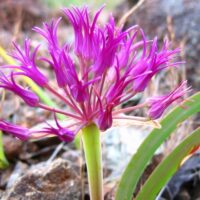
This is one of our favorite native bulbs and it is rarely available in nurseries. In spring or summer, dense, rounded clusters of flowers, ranging in color from light to deep pink, sit atop thick, flattened stems up to 10 inches high. The strap-like leaves are few and don't distract from the chunky blooms. Needs excellent drainage and a lean, rocky soil. Once the flowers are done, allow the plant to go dormant with no irrigation. Native to rocky, sunny outcrops from Santa Cruz up to southwestern Oregon. Nestle among rocks and little succulents to show this unusual onion off to your friends. Works well in a container where its somewhat tricky requirements can be more easily met.
Alnus rhombifolia
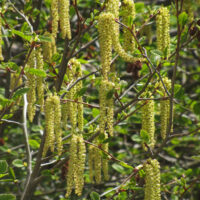
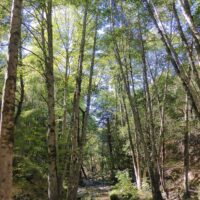
From creeks and rivers throughout California, the white alder rapidly grows to become a large tree, reaching to 50 ft. or more at maturity. Serrated green leaves produce an excellent canopy above the straight, silvery-gray trunk. In winter, when the leaves have fallen, the ghostly branches make a striking silhouette with dangling catkins from the branch tips. An excellent plant for creek restoration where its aggressive roots help to stabilize banks. Keep away from irrigation pipes and foundations. Needs regular moisture and sun to light shade.
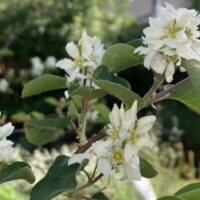
Amelanchier alnifolia
A common native shrub or small multi-trunked tree often found growing along seasonal streams. Serviceberries provide a touch of autumn color where the leaves turn a lovely butterscotch yellow. The white spring flowers are followed by dark blue-purple fruits coveted by ring neck doves in the wild. Sun to partial shade. Moderate to infrequent water. Many butterflies use this species as a larval host, such as the California hairstreak and the Ceanothus silkmoth. Grows well in a large container.
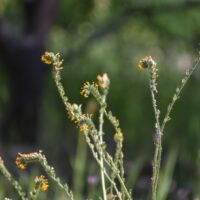
Amsinckia menziesii
A bright, yellow-orange ANNUAL with curled clusters of little trumpet-shaped flowers resembling the scrolled head of a violin. Flower stalks of one-to-three feet tall gradually unfurl with new blooms from mid-spring to early summer. The warmly-colored blossoms are a great nectar source for butterflies and develop into seeds adored by goldfinches and other songbirds. This grassland native adapts to the garden setting, where it prefers full sun and occasional irrigation. Will self-sow.
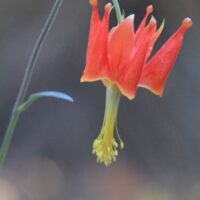
Aquilegia eximia
Large, orangey-red flowers with yellow stamens adorn this beautiful and uncommon native columbine. The pendant, brightly colored blossoms are larger than those of the western columbine but just as attractive to hummingbirds. Forms a 1 ft. high mound of foliage with flowering stalks reaching up to 5 ft. tall. Native to the Coast Ranges from Mendocino to Ventura Counties often on serpentine soils. Provide full sun to part shade and only water enough to prevent the soil from drying out completely. In areas far away from the coast provide a little shade from the hot afternoon sun. This species is a little more drought tolerant than the more common Western columbine.
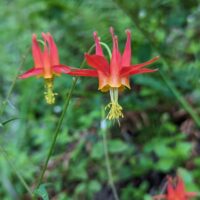
Aquilegia formosa
A popular native perennial with fern-like foliage and wonderful, nodding, spurred blossoms of red and yellow. Best with a little shade and moderate to regular moisture, but will tolerate full sun in somewhat cooler climates. The flower stalks reach 1 1/2’ to 3’ tall, with the grey-green foliage forming a mound of about 1 ft tall and wide. Flowers attract hummingbirds, while the seeds are relished by small birds such as sparrows and Juncos. If seed pods are left on the plants, you may get volunteer seedlings in the fall.
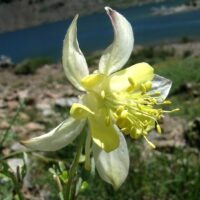
Aquilegia pubescens
Found on open, rocky slopes in the southern Sierra Nevadas in sub-alpine and alpine plant communities. Low rosettes of divided, blue-green foliage, sprout from a taproot. Flower stems rise 10 - 20 inches above the fragrant foliage and carry upward facing, nectar rich, long spurred flowers, perfectly positioned for pollinating hawk moths, hummingbirds and butterflies. The flower color is variable and runs the gamut from cream to yellow to pink, often in delicate hues rather than solid colors, except for an occasional pure white. Hybridizes freely with the native red columbine, which invites various shades of red to the flower color possibilities. Grows well in low elevation gardens, given light shade and summer water.
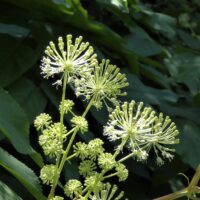
Aralia californica
A striking and dramatic native perennial for shady areas with regular water. The elk clover boasts tropical looking foliage 4 - 8 ft. tall with stalks of white, ball-like flower clusters followed by purple berries. In the autumn the foliage turns yellow and dies to the ground, returning with exuberance in the spring. Birds relish the fruits. Deer resistant.
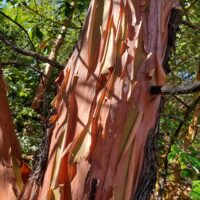
Arbutus menziesii
A beautiful native evergreen tree which features handsome, smooth, reddish bark that peels in thin flakes. Leaves are leathery and shiny dark green. Large clusters of white flowers give way to red-orange berries that can remain into winter if the birds don't get them. It can be tricky to establish, necessitating planting in the fall. MUST have good drainage and just enough water to establish. Once established give only infrequent deep waterings or no water at all. Bees and hummingbirds love the flowers.
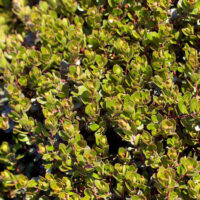
Arctostaphylos ‘Emerald Carpet’
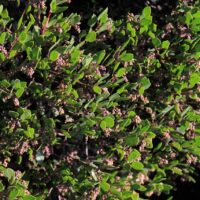
This popular manzanita forms a wonderful, dense, green groundcover around 1 ft. tall by 6 ft. wide. Clusters of small, white, urn-shaped flowers decorate the plant in early winter. A natural hybrid discovered on Haven's Neck on the southern Mendocino Coast. Often planted en mass to create a large scale groundcover. Somewhat slower growing than bearberry and slightly taller over time. Enjoys full sun near the coast but does best in hotter areas with some afternoon shade. Needs moderate water once established.
Arctostaphylos ‘Howard McMinn’
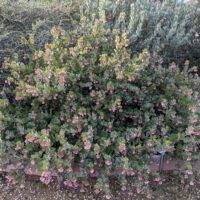
One of the most popular of the manzanitas, for several good reasons. It is rounded in form and profusely branched, growing 5 - 7 ft. tall. It has shiny green leaves and abundant light pink flowers. Beautiful mahogany trunks create a wonderful sculptural effect. The dense foliage responds exceptionally well to pruning - even shearing, and tolerates a far greater range of soils and watering regimes than most manzanitas.
Arctostaphylos ‘John Dourley’
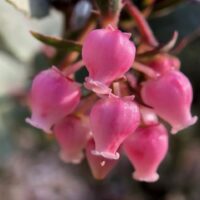
A beautiful mounding manzanita growing 3-4 ft. tall and 6 ft. wide.Bluish-green leaves with gorgeous bronzy new growth, abundant pink flowers followed by red fruits make this vigorous grower a wonderful addition to the garden. Plant in sunny areas with little to no water once established. The early blooming manzanitas provide an important nectar source for hummingbirds and bees.
Arctostaphylos ‘Lester Rowntree’
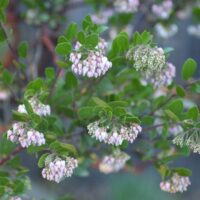
A stunning manzanita named for the early native plant pioneer and groundbreaking woman, Lester Rowntree, who provided the seed. Shapely, upright branches sport bluish foliage with unusual coral-pink, urn-shaped flowers very early, often beginning in October. A special feature for an upright manzanita is the large, glossy, red berries which ripen in the summer. The reddish bark, gorgeous foliage and flowers make this an excellent candidate for sunny areas with little to no summer water once established. This selection, involving A. pajaroensis, develops into a striking specimen, growing 8-10 ft. tall and wide with time. Its early flowering period offers nectar to hummingbirds and bees when not much else native is blooming. Introduced by Rancho Santa Ana Botanic Garden.
Arctostaphylos ‘Lutsko’s Pink’
One of the very best ornamental manzanitas, named by Cal Flora for the landscape architect who introduced it: Ron Lutsko. An upright shrub 4 -7 ft. tall, with dark glossy green leaves and covered with blossoms in spring which are blushed pink. Mahogany trunks develop a beautiful contorted shape. Good for dry sunny spot.
Arctostaphylos ‘Pacific Mist’
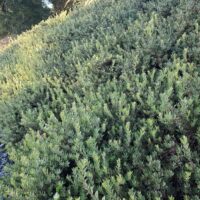
A broadly spreading shrub, fast growing for a manzanita, eventually forming a good dense ground cover 1.5 - 2.5 ft. tall by 10 ft. wide. Handsome gray-green leaves with deep reddish-brown bark. Small clusters of white urn-shaped flowers in late winter are pretty, but it is not a heavy bloomer. This fine introduction from Rancho Santa Ana Botanic Garden is proving to be dependable and disease resistant. Plant in sun or light shade. More drought tolerant than the popular bearberries. In cool summer areas may need no additional summer water once established. In hotter inland sites,occasional deep summer waterings is best. It is believed to be a cross involving the rare Bonny Doon manzanita.
Arctostaphylos ‘Sentinel’
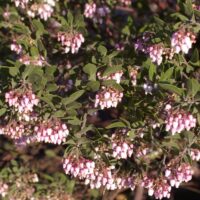
Somewhat more upright in habit but less dense and less uniform than Arctostaphylos 'Howard McMinn', it is a far heavier bloomer with LOTS of vivid pink blossoms and soft grey green leaves. A relatively easy and dependable manzanita, growing 6 - 8 ft. tall and wide, though reputed to be less tolerant of irrigation and heavy soils than A. ‘Howard McMinn’, the most adaptable of all manzanitas. Distinctive burgundy-colored bark. Early nectar source for hummingbirds and bumble bees.
Arctostaphylos ‘Sunset’
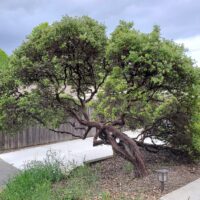
A handsome manzanita growing 6 ft. tall and wide with especially attractive coppery-red new growth. Flowers are urn-shaped pinkish-white. Exfoliating shaggy bark reveals smooth red toned trunks. Can be pruned to expose the beautiful sinuous branching structure. A naturally occuring hybrid discovered near Prunedale in Monterey Co. involving A. pajaroensis and A. hookeri. Tolerant of heavy soils and heat as well as occasional irrigation.
Arctostaphylos ‘White Lanterns’
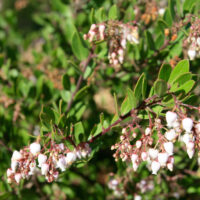
This lovely manzanita believed to be a selection of A. densiflora originated at the Santa Barbara Botanical Gardens many years ago, but today it is a rare find in nurseries. Slowly growing to a dense mound 3-5 feet tall and wide, this tough and disease resistant plant is equally at home as a beautiful specimen or massed in large plantings. Especially heavy blooming, this shrub is covered with clusters of white blossoms opening from pink buds over a long period in late winter. Excellent early nectar source for hummingbirds and bees. Plant in full sun to very light shade with little to no water once established.
Arctostaphylos auriculata
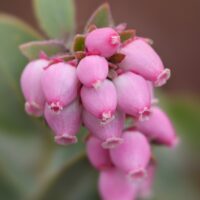
From the rocky slopes of Mount Diablo comes this rare and delightful manzanita. Smallish, fuzzy, grey leaves densely cover the branches over mahogany-red trunks. Late winter brings flowers ranging in color from pink to white. This species grows slowly and densely to about 5 or 6 ft. tall and at least as wide. Needs full sun. Make sure to provide excellent drainage and little to no irrigation once established.
Arctostaphylos bakeri ssp. bakeri ‘Louis Edmunds’
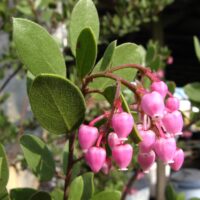
A beautiful and durable upright manzanita reaching 5 - 7 ft. tall and nearly as wide. This species is native to Sonoma Co. where it is considered very rare and threatened by development. Handsome gray-green foliage with wonderful purplish-brown trunks contrast nicely with showy clusters of pink urn-shaped flowers in spring. Great for sunny areas where it endures heat and drought but enjoys an occasional deep watering. The manzanita berries can attract mockingbirds, robins, and cedar waxwings. It provides low shrubby cover for quail and wrentits and its flowers provide nectar for hummingbirds.